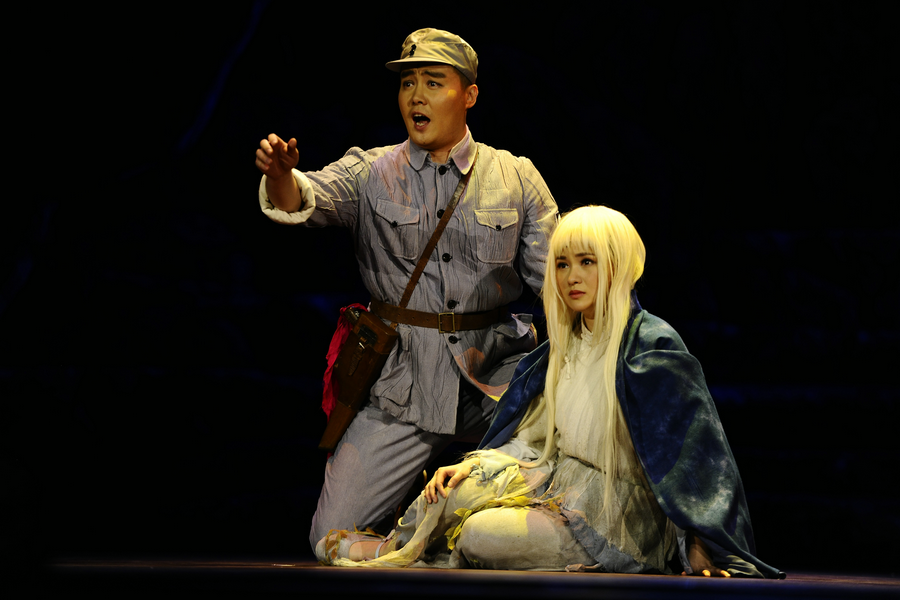
The White Haired Girl
Overview
The opera, composed by Yan Jinxuan, was first performed in 1945 with artist Wang Kun in the leading role. It is regarded as a milestone in the development of Chinese theater.
The opera is an influential work in the realm of Chinese performing arts, serving as a representation of the socio-political climate of its time. It has undergone numerous adaptations and remains a significant cultural artifact in China.
Plot Summary
The story centers on the life of Xi'er, a girl born to a humble life in northern China. Xi'er escapes to hide deep in mountains after her father Yang Bailao is killed by the greedy and cruel debt collector Huang Shiren.
Due to her difficult circumstances and prolonged malnutrition, she loses the vitality of her youth, causing her hair to change color. The birth of a new China ultimately allows her to lead a normal life once again.
Adaptations and Influence
Since its debut, a number of remakes of the opera have appeared, including a film adaptation in 1950 and a Peking Opera performance in 1958. In 1965, it was made into a ballet by the Shanghai Dance School, which was later performed by the Shanghai Ballet. The ballet adaptation marked a significant development in Chinese ballet, blending traditional Chinese elements with Western dance forms. Each version has sought to honor the original story while exploring new artistic expressions.
Modern Revivals
In 2015, to commemorate the 70th anniversary of its original performance, a new version of The White Haired Girl was staged with celebrated Chinese opera artist Lei Jia in the lead role. This revival underscored the opera's enduring appeal and its continued relevance in Chinese cultural discourse. The Shanghai Ballet has regularly included the ballet adaptation in its repertoire, illustrating the work's lasting impact on Chinese ballet and performing arts.
Cultural Significance
The White Haired Girl is more than just a performance piece; it is a cultural symbol of endurance and change. It reflects the struggles and eventual liberation of the Chinese people, resonating with audiences on both a historical and emotional level.
The opera's ability to be reinterpreted and adapted over decades speaks to its universal themes and its significance in Chinese cultural heritage. Through its various adaptations, The White Haired Girl has maintained its role as a vessel for Chinese artistic expression and a touchstone for discussions on cultural identity and transformation. Article reference1. 'The White Haired Girl' staged in Shenzhen. chinadaily.com.cn. 20212. White Haired Girl – a good tale. chinadaily.com.cn. 2015Photo Gallery(5 pictures)CategoriesArtsTagOpera and DramaCatalogue1. Overview2. Plot Summary3. Adaptations and Influence4. Modern Revivals5. Cultural Significance- - - []








